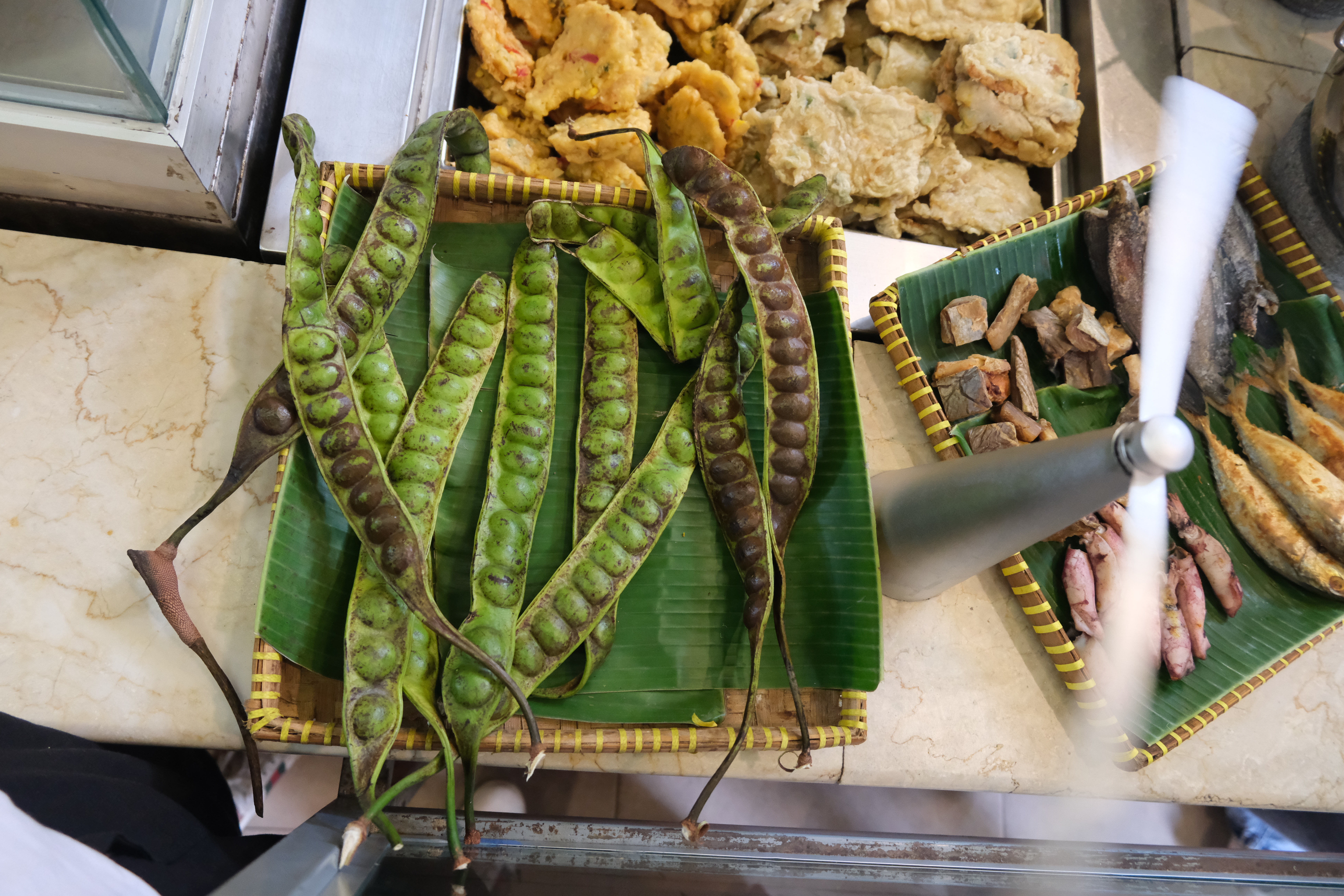
While the larger world is busy being divided over durian, we Indonesians have something smaller, cheaper and stinkier to unite against the world about. Petai. Or pete, if you are saying it the way we actually say it. Or stinky beans, if you have only ever met it in an English menu translation.
It is bright green. It comes in a long, twisted pod that hangs off a tree in bunches, and the tree can grow forty metres tall, which is a fact I did not know until recently and now cannot stop thinking about. That is a five-storey building’s worth of stink, suspended above your head.
I also thought petai only grew in Indonesia. It does not. It grows right across this part of the world: Malaysia, Brunei, southern Thailand, the Philippines, Myanmar, and up into northeast India. In Thailand it is sataw, and if you have eaten pad sataw goong in a Thai restaurant, congratulations, you have eaten petai with prawns and did not know it. In India’s northeast it is yongchak. So the argument is not just ours. We are simply the loudest about it.
The smell
Petai has a strong taste and an even stronger smell, the kind that lingers well after you have finished eating. Chemically, it’s sulphur, in the same broad neighbourhood of chemistry that makes garlic garlic and durian durian.
But it is good. Good enough that I plan my life around eating it.
I prefer it at home because I can brush my teeth immediately afterwards. If I have to eat it out, I load up on mints. This is not a small operation. This is logistics.
And it is still not enough to stop me, because it is genuinely hard to resist the udang petai in nasi Padang. Prawns, chilli, petai. Whatever restraint I claim to have does not survive contact with that plate.
Petai kacamata
Not all petai is stinky, as it turns out.
I recently discovered petai kacamata, an old-fashioned Minang dish you almost never see in Padang restaurants anymore. Kacamata means spectacles, and the name is literal. The petai is sliced thin on the diagonal, pod and all, so each slice looks like a little pair of glasses. Fry the slices until crisp, toss them through sambal goreng, and finish with dry-fried teri.
It is delish. Genuinely.
It also lacks all the umami that petai brings, and now I know why. When you slice it that way, you are eating mostly pod, not seed. The crunch is the point. The funk lives in the bean, and you have just sliced the bean into a garnish.
Worth eating. Not a substitute for the OG petai.
It is people’s food
Petai is not for every day. But in my opinion, far more Indonesians eat petai and love petai than will admit it in company.
It is people’s food. It belongs on the same shelf as tahu, tempe, kecap and cabe. Nothing about it is precious. It is not a delicacy; it is not a flex; it is not something anyone plates up to impress you. It is a flavour enhancer that has been doing quiet work in Javanese and Sumatran kitchens for as long as they have existed.
So should you eat it?
Now I have set myself the burden of closing this by telling you whether to try it.
Yes. If you’re culture-curious or a foodie, and there is a nasi Padang place near you (and there are more Indonesian restaurants opening every year, so there probably is), order the udang petai.
But be prepared.
Brush your teeth. Glug the mouthwash. And do not eat too many of them in one sitting, because your pee will stink of them afterwards, especially if you are not drinking enough water.
Oh god. That is going to make you less tempted, isn’t it?
Try it anyway. Because Indo-umami.
Follow me on Instagram @KultureKween for more recent updates.


[…] Fava Beans (which, from the look of them, reminded me of Indonesian petai). I remember I actually liked fava beans, though I couldn’t remember where I’d eaten them […]