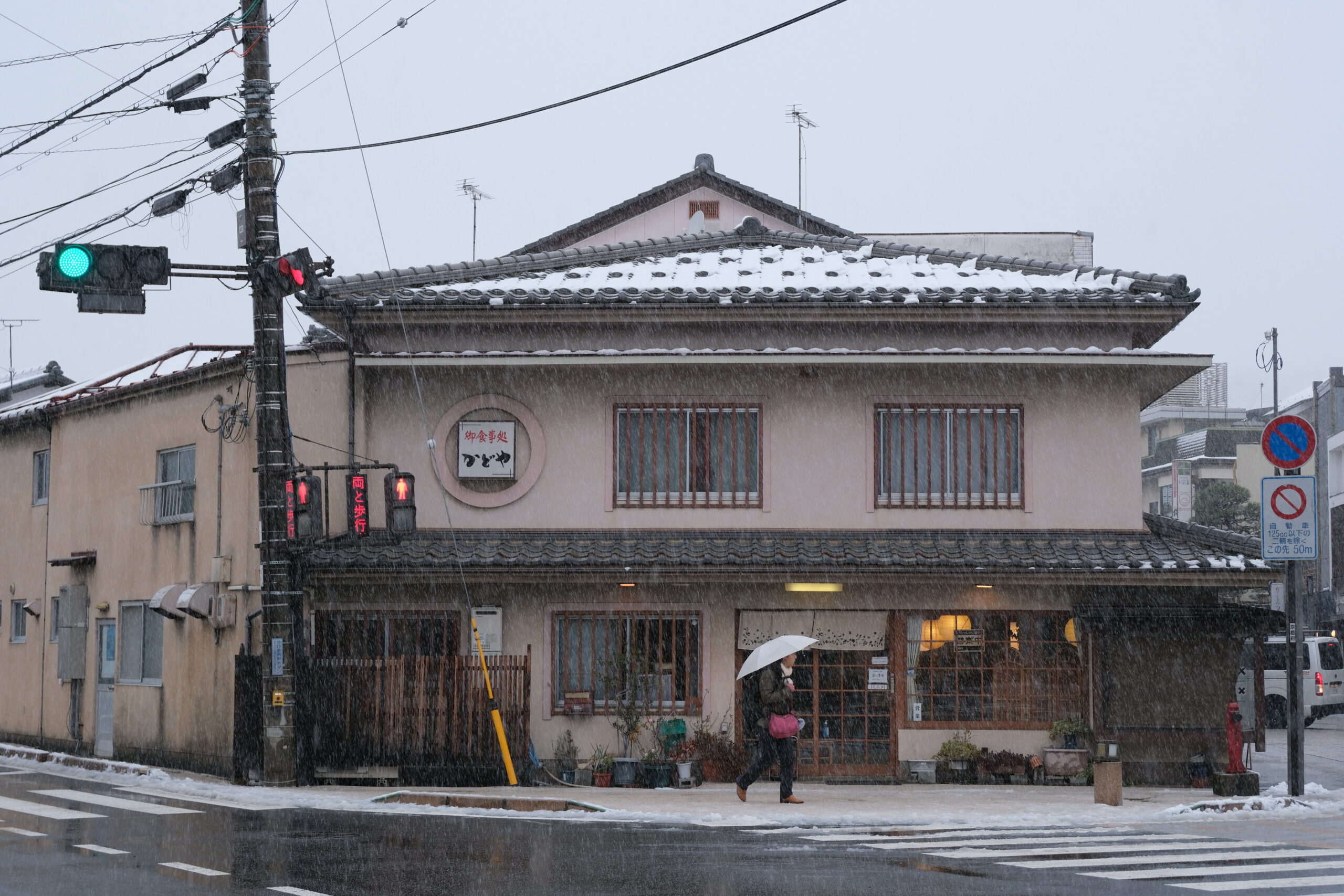
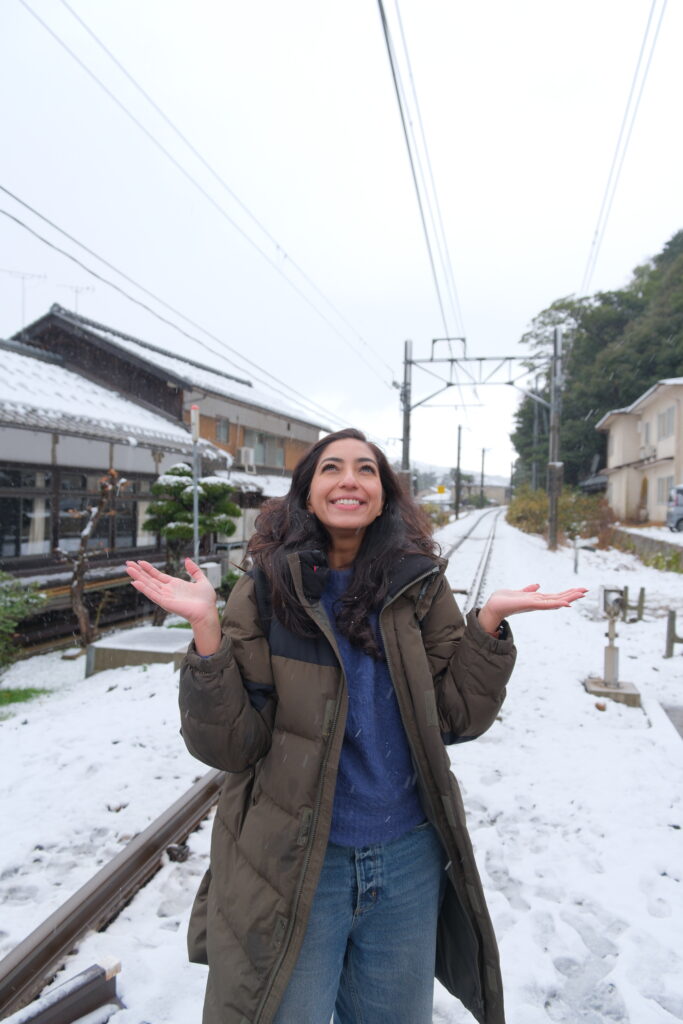
It was already past midday when we arrived in Amanohashidate, and heavy snow was falling. Literally meaning “bridge to heaven,” the name Amanohashidate refers to the long pine-covered sandbar stretching across Miyazu Bay, which, when viewed from above, appears like a pathway connecting the earth to the sky.
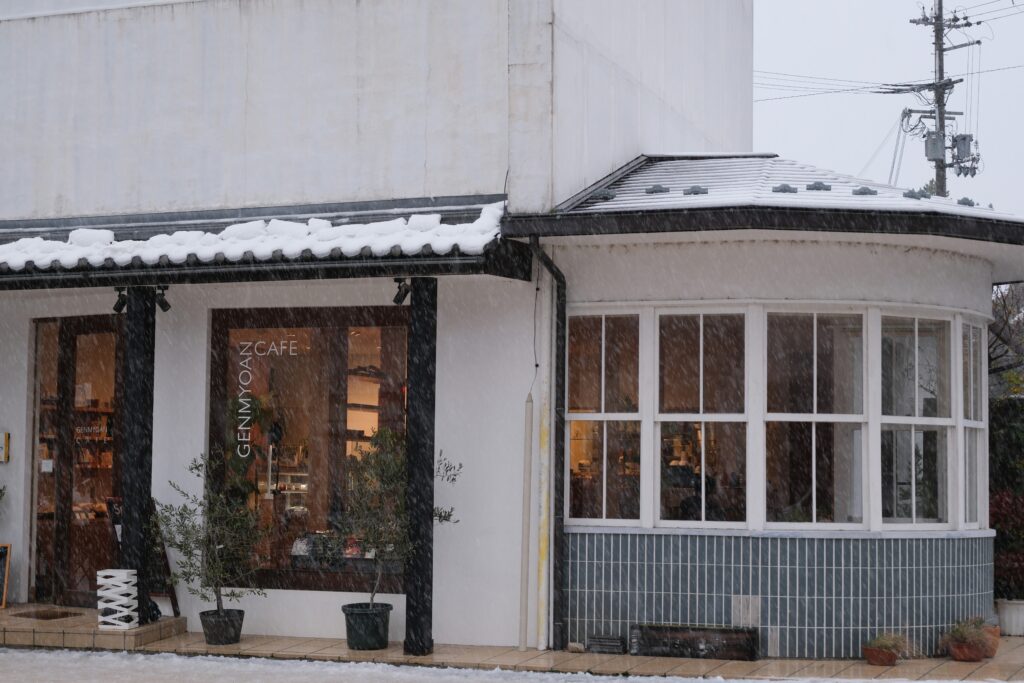
But we didn’t immediately explore the town. Instead, we hid inside a café — Genmyoan Café — simply to escape the snow. Fafa opted for coffee and cake, while I ordered hot milk.
Let this be my Japan travel PSA: rural Japan’s milk is unbelievably good. It’s sweet, comforting, and somehow feels extra wholesome. I’ve now started a small mission to taste hot milk everywhere we go in the Japanese countryside.
The café felt incredibly cozy inside. I chose it partly because of the beautiful little reading nook — the kind I’ve always dreamed of having in my own home. Luckily, the table was empty when we arrived, so we claimed it and stayed there for quite a while. If we had stayed the night in Amanohashidate, I wouldn’t have minded spending hours there journaling and daydreaming.
Chair Lift to Amanohashidate View Land
But of course, that wasn’t the main reason we came to Amanohashidate. Eventually, we had to venture back out to see its famous sandbar, lined with thousands of pine trees stretching across the bay like a natural bridge. The best way to see it is from above, which meant taking the chair lift up to Amanohashidate View Land.
With heavy snow falling around us, we made our way to the entrance and queued for the chairlift.
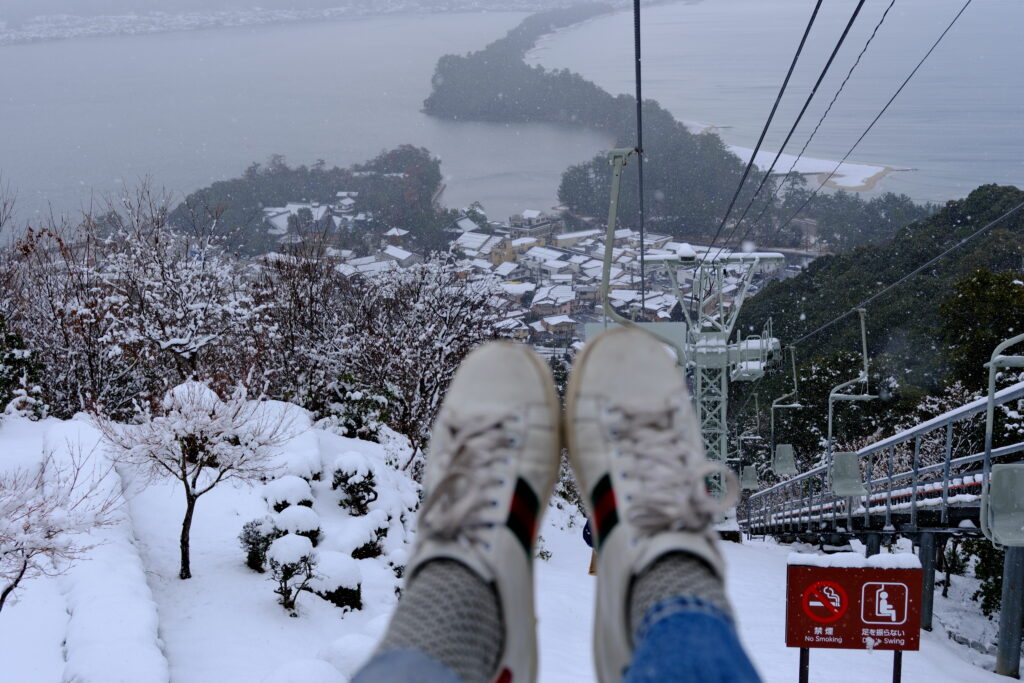
You know, I’m fairly certain this wasn’t my first chair lift. I must have taken one somewhere before. But I genuinely can’t remember where, and this blog isn’t helping because apparently I used to call everything a cable car. Either way, I had definitely never taken one in heavy snow before.
When it was my turn, I climbed onto the chair, and Fafa followed behind me.
As the chair slowly lifted me above the snowy trees, I found myself thinking about how some experiences feel easier when you’re younger. Maybe with age comes a little more fear. I wondered whether I’d still have the courage to do something like this twenty years from now. But maybe I shouldn’t sell myself short — perhaps future me will still love weird and adventurous things like this just as much.
The Upside Down View of Amanohashidate?
At the top, there’s a lookout platform where you’re supposed to view the sandbar upside down. There’s even a designated platform built specifically for this.
There was an instruction poster explaining the traditional way to admire Amanohashidate, called matanozoki. It involves bending over and looking at the scenery upside down through your legs. When viewed this way, the sandbar is said to resemble a dragon flying up into the sky, which is where the poetic idea of the “bridge to heaven” comes from.
Yes, it basically involves mooning the landscape without actually pulling your pants down. I still don’t fully understand how this became a Japanese sightseeing tradition, but some people were definitely doing it.
I opted for another beloved activity instead: stamping the chair lift stamp into my ekistamp book, which is now sporadically filled with stamps I’ve collected whenever I spot them during my travels around Japan — though not as many as you might think, I should add.
Amanohashidate Shrine
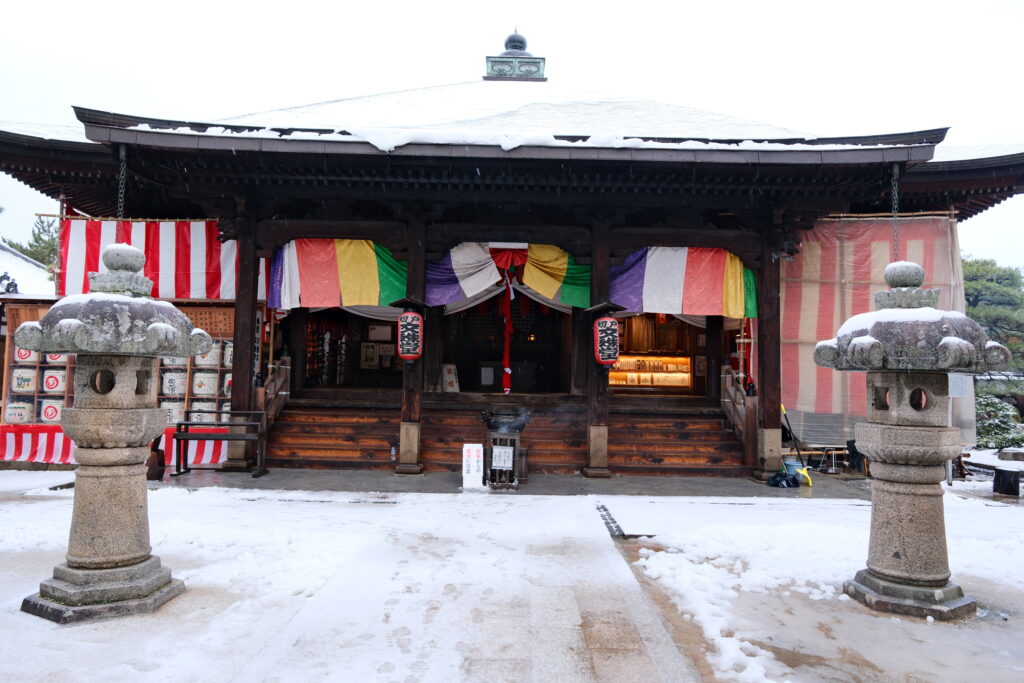
Our next stop was Amanohashidate Shrine (Amanohashidate Jinja), a small shrine located along the sandbar itself. The shrine is associated with love and safe travels — my favourite kind — and like many shrines in Japan, it carries a quiet, peaceful atmosphere that feels even more magical when everything is covered in snow.
The snow-covered shrine grounds were absolutely beautiful. As usual, I said a little prayer before making my way to the side counter to ask the monk for a goshuin stamp for my collection. By now, I have more goshuin stamps than ekistamps. Go figure.
Sardine Burger at Café du Pin
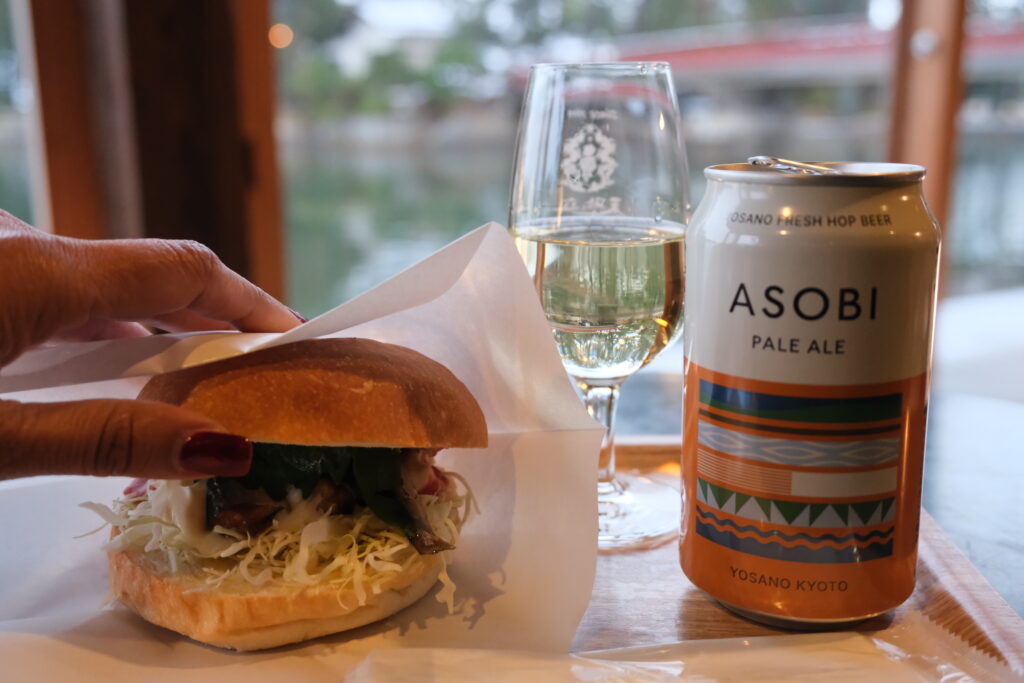
After that, it was Fafa’s turn to choose the next stop. We ended up at Café du Pin.
This café is easily one of the most beautiful cafés I’ve ever sat in. It’s warm and cozy, and the view outside is incredible — a bright red bridge framed by falling snow and quiet pine trees. It almost looked like a movie scene. Fafa ordered a sardine burger while I had a glass of wine.
I’ve already decided that the next time we visit Amanohashidate, I want to stay here for a day or two and simply slow down.
BRB Amanohashidate
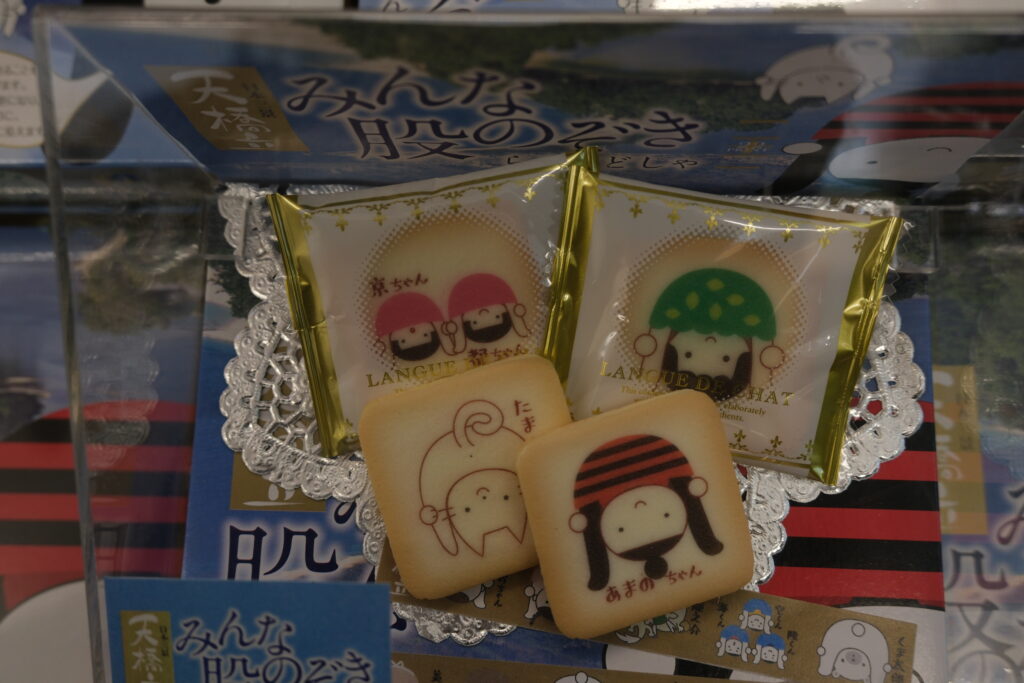
Our final stop before boarding the bus back was the gift shop. I picked up a few fridge magnets, pudding, crab cookies, and other omiyage — most of which we somehow managed to finish before even reaching Kyoto.
Amanohashidate — even though I still struggle to pronounce it and absolutely cannot spell it without Google — is easily one of the most beautiful places I’ve ever set foot in.
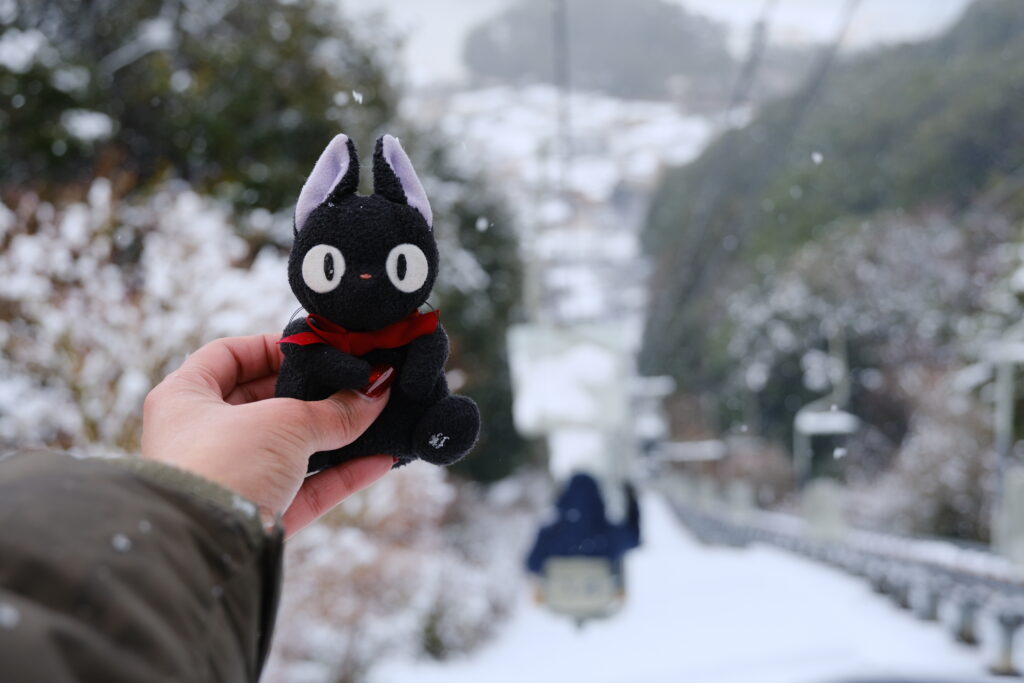
And I’m incredibly grateful that I got to see it. I’m also ready to go back.
Follow me on Instagram @KultureKween for more recent updates.

[…] Omakase Fukuoka 🖋️ Ine Funaya Kyoto: The Most Beautiful Seaside Village in Japan 🖋️ Snow, Hot Milk, and Chair Lifts in Amanohashidate Japan 🖋️ Making Matching Rings in glanta Kyoto Ring Making Workshop 🖋️ Discovering Kappo […]
[…] wanted something that commemorated that moment in Japan. I suggested things like Kyoto 2026 or Japan 2026, but Fafa vetoed […]
This was such a beautiful day. Boleh stay here
asik! stay yuk…